.jpg)
Waste management
Chemical storage is still too often treated as a secondary design consideration. Tanks are specified late in the process, compatibility is checked, wall thickness calculated, and attention moves elsewhere. That approach may once have been sufficient when duty cycles were predictable and regulatory oversight less demanding, but it no longer reflects how modern process plants actually operate.
Today’s aggressive chemicals - hydrochloric acid, sodium hypochlorite, caustic soda and oxidising blends - are rarely stored under steady-state conditions. Concentrations vary, temperatures cycle, aeration changes, and cleaning regimes introduce additional exposure mechanisms. Under these realities, traditional carbon steel and lined steel tanks tend to fail in familiar but costly ways: under-film corrosion, localised attack at welds and nozzles, lining disbondment, and a gradual shift from known condition into managed uncertainty.
At the same time, regulatory expectations have evolved. Frameworks such as COSHH, DSEAR and COMAH now place emphasis on demonstrable containment integrity throughout an asset’s life - not merely initial compliance. This raises an awkward but necessary question for process engineers: why are storage vessels still being specified as though long-term material behaviour were someone else’s responsibility?
The increasing availability of advanced thermoplastics and fibre-reinforced composites has expanded the options for chemical storage. Yet it has also exposed a persistent weakness in material selection practice. Compatibility charts remain useful, but they are blunt tools. They seldom account for permeation, concentration effects, oxidising potential, dissolved gases, or the mechanical consequences of sustained load at elevated temperature.
Materials such as PP, HDPE, uPVC, cPVC, PVDF and ECTFE exhibit markedly different behaviours over time and under stress. The same is true of GRP laminates based on vinyl ester, isophthalic or bisphenolic resin systems. Treating these materials as interchangeable “plastic tanks” ignores the reality that their failure mechanisms are governed by creep, strain, weld integrity and laminate architecture, not corrosion rate.
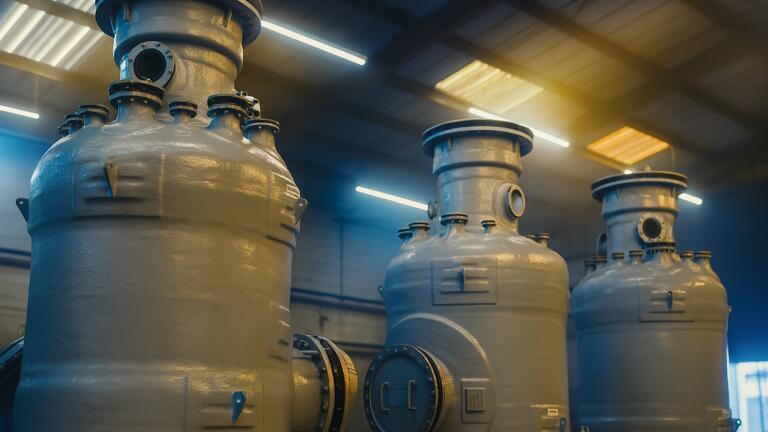
As a result, many robust storage solutions now adopt deliberate composite construction. Thermoplastic liners manage chemical exposure and permeation, while GRP structures carry mechanical loads and control deformation. Resin systems are selected to suit oxidising or reducing environments, and fibre orientation and local reinforcement are engineered to handle nozzle loads, thermal gradients and cyclic stresses. This is materials engineering in its proper sense - not procurement-led substitution.
A persistent misconception in chemical storage design is that minimum wall thickness equates to adequate safety margin. For polymers and composites, this is rarely the dominant risk. More common failure modes include vacuum collapse during pump-out, creep under sustained hydrostatic head, localised strain at penetrations, and buckling under wind or seismic loads.
Modern design approaches address these mechanisms directly. While standards such as BS EN 13121-3 provide a useful baseline, credible designs go further: finite element assessment of supports and nozzles, explicit vacuum and sloshing checks, and defined strain limits based on long-term material behaviour rather than short-term strength. The critical design question shifts from “does it meet the code?” to “will it behave predictably over 20 years of service?”
Chlorine-bearing systems illustrate clearly why this matters. Elemental chlorine and hypochlorite solutions combine aggressive oxidising chemistry with toxicity and, in some cases, challenging gas–liquid equilibrium behaviour that pushes conventional metallic containment to its limits.
In a recent installation, a two-stage chlorine scrubbing system was engineered to reduce inlet concentrations exceeding 534,000 mg/m³ to below 1 mg/m³. Separate 1% and 18% sodium hydroxide stages were employed to balance reaction kinetics, mass transfer efficiency and by-product control. Downstream, a catalytic Hydecat reactor achieved greater than 99.99% destruction of sodium hypochlorite at feed strengths above 56,000 ppm.
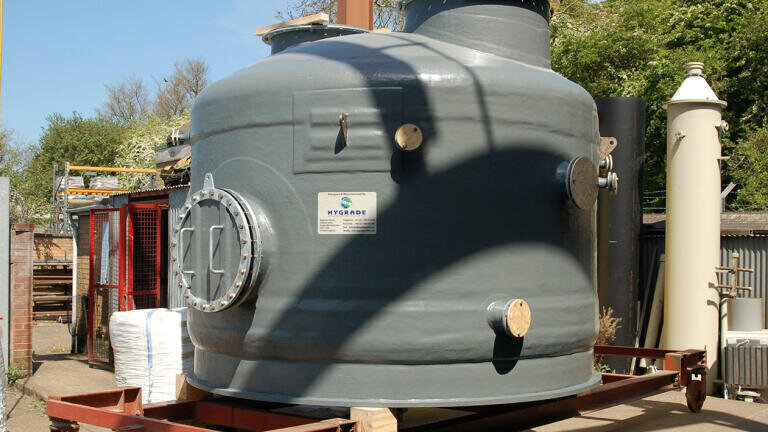
What stands out is not the headline performance, but the integration of process chemistry, materials selection and containment design. Thermoplastic linings were specified to manage oxidising exposure and permeation risk, while GRP structures provided mechanical strength and accommodated complex nozzle arrangements. Containment was designed as part of the process solution - not appended afterwards. That distinction often determines whether a system simply complies or remains stable and predictable over time.
For chemical and process engineers, the conclusion is unavoidable: storage vessels can no longer be treated as passive components. Advanced plastics and composites do not reduce the need for engineering judgement - they demand more of it. The relevant questions are no longer simply “will it corrode?” but “what strain will this material experience over its life, how will it deform, and how will we detect changes in behaviour?”
Plants that confront these questions early gain more than improved containment. They reduce inspection burdens, avoid unplanned outages, and build confidence in systems that often sit at the boundary between process safety and environmental risk. That outcome is achieved not through materials alone, but by recognising chemical storage as a first-order engineering problem - rather than an afterthought.


 Product directory














-from-Chesterton-House-Farm,-with-Giles-Russell-from-Midland-Slurry-Systems.jpg)