Waste management
A massive new industry is waiting to be built from Europe’s growing mountain of discarded clothing. Every year, some 10 billion kilograms of textile waste are thrown away across the continent. With textile fibres valued at €2–3 per kilogram, the potential business opportunity runs into the billions of euros.
“Only about one percent of the world’s textiles are recycled back into textiles today,” notes Ali Harlin, Research Professor at VTT Technical Research Centre of Finland. “The barriers are not technological, but regulatory gaps and the complexity of textile raw materials.”
The EU is revising its Waste Framework Directive, which would place textiles under Extended Producer Responsibility (EPR). This would make brands themselves accountable for organising textile collection and recycling.
“The EU is leading globally on textile recycling regulation, but progress has been painfully slow,” says Harlin. “Without proper regulation, we won’t see meaningful change in recycling rates.”
Finland has been at the forefront of textile recycling research. The Telaketju network and its Telavalue project have spent the past decade developing solutions to cut waste and improve circularity.
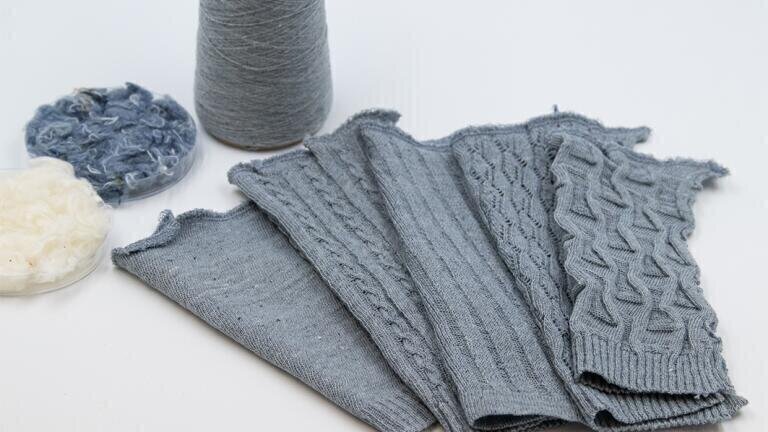
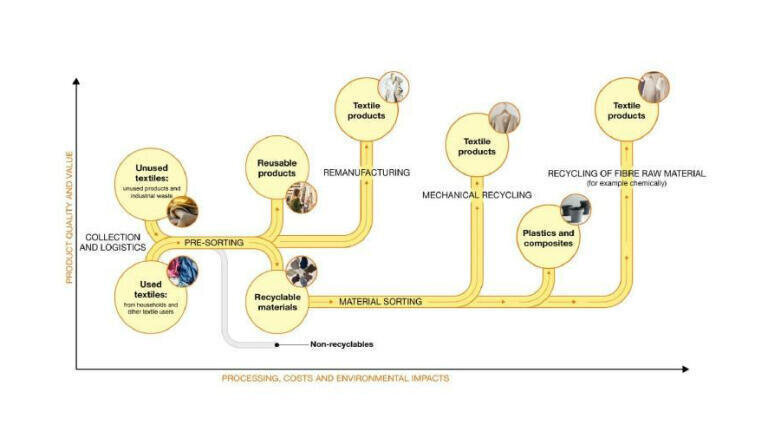
“The principle is always minimal processing,” explains Pirjo Heikkilä, Principal Scientist at VTT. “If repair or reuse is impossible, the next best option is mechanical fibre recycling, where textiles are shredded back into fibres for reuse. For more degraded materials, we turn to chemical recycling, breaking fibres down to polymer or monomer level for rebuilding.”
The Telavalue project evaluated recycling methods not only for technical performance, but also for their economic, environmental, and social impacts.
Scaling up textile recycling could bring parts of the production chain back to Europe. Today, advanced recycling technologies are being developed mostly in Northern and Western Europe, while manufacturing capacity is concentrated in the East and South.
“To make recycling truly work, Europe needs a coordinated ecosystem,” Harlin stresses. “A single chemical recycling plant needs feedstock from about ten mechanical fibre plants. That means hundreds of facilities across Europe.”
Technological advances are rapidly expanding what can be recycled. Cotton can already be efficiently regenerated, with Infinited Fiber Company in Finland building a new factory dedicated to it. Soon, cotton and polyester will be reliably separable, opening the door for advanced chemical processes similar to those used in PET bottle recycling.
Applications stretch far beyond fashion. “Recycled fibres can become new fabrics, nonwovens, wind turbine blades, vehicle insulation – even additives in concrete and asphalt,” says Harlin. “They can make concrete lighter and more fire-resistant, and asphalt more durable.”
The biggest hurdle remains ultra-fast fashion. Low-cost, low-quality garments are often made from mixed fibres that are expensive and technically difficult to recycle.
Workwear, however, shows a more promising path. “Because uniforms are usually provided as a service, quality and maintenance are prioritised,” says Heikkilä. “The business model favours durable materials, and because the fibre composition is well-documented, end-of-life recycling is far easier.”
Still, as Eetta Saarimäki, Senior Scientist at VTT, points out, not all textiles can be looped back into clothing. “Through thermo-mechanical recycling, even complex and blended textiles can still be repurposed into valuable applications outside the textile industry.”


 Product directory














-from-Chesterton-House-Farm,-with-Giles-Russell-from-Midland-Slurry-Systems.jpg)