Air clean up
Published over 11 years ago. See the latest and most current information on Air clean up.
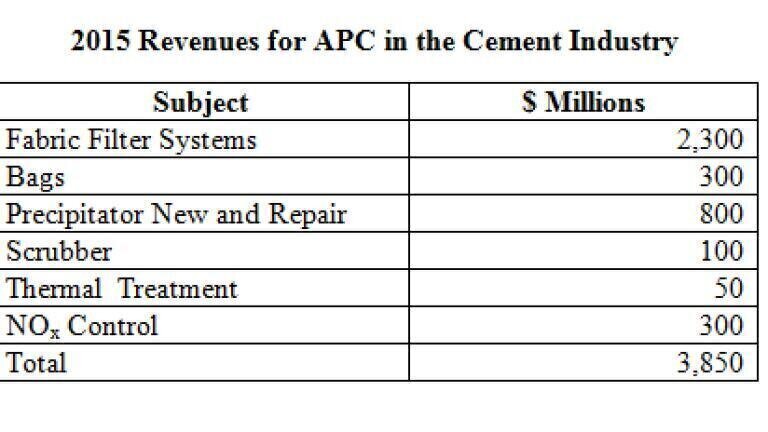
The combination of new plant construction and retrofits to existing plants will boost the air pollution control market for the cement industry to $3.85 billion in 2015. This is the latest conclusion from the McIlvaine Company based on aggregating forecasts in five separate reports.
The biggest investment will be for fabric filter systems. Most new cement plants use fabric filters for the kiln exhaust as well for many grinding and transfer processes. NOx control is increasingly required. Most plants use selective non-catalytic reduction (SNCR). A few use selective catalytic reduction (SCR). A new NOx and particulate control option is the catalytic filter element. This product is available from FLS and Clear Edge.
Most of the precipitator investment will be in repair and upgrades. India has new regulations applying to the 194 cement plants located there which require them to reduce kiln emissions below 30 mg/Nm3. The average plant presently emits more than 100 mg/Nm3.
Many cement plants have chosen to remove the internals of existing precipitators and install fabric filter elements.
The U.S. has tough new air toxic rules. It was anticipated that there would be large expenditures for wet scrubbers and thermal treatment systems to meet the requirements. However, the industry has selected to use low cost capital approaches such as dry sorbent injection.
 Product directory