Water/Wastewater
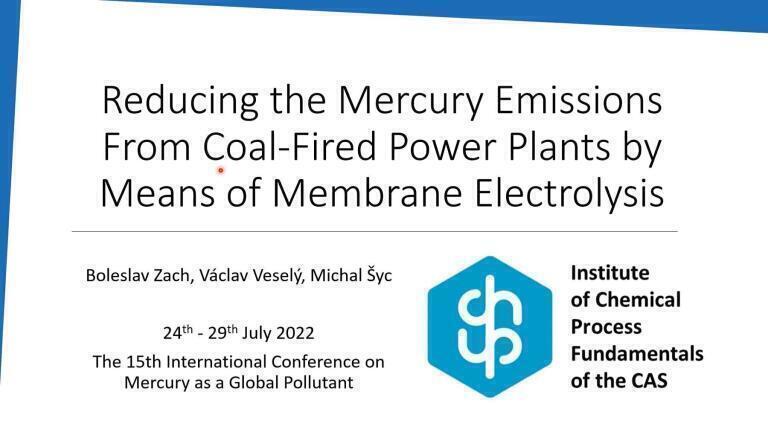
In this technical presentation, Dr Václav Veselý from the Institute of Chemical Process Fundamentals at the Czech Academy of Sciences introduces a novel approach for reducing mercury emissions from coal-fired power plants through membrane electrolysis.
Mercury, a hazardous pollutant emitted during coal combustion, appears in three forms within flue gases: metallic mercury, oxidised mercury,and mercury adsorbed onto particles.
For the purposes of emission control, the focus is primarily on metallic and oxidised forms.
Metallic mercury can exist in both liquid and gaseous states. But it is practically insoluble in water.
In contrast, oxidised forms – such as mercury chlorides and bromides – are more water-soluble and generally easier to capture using wet scrubbing techniques.
However, in many power plant emissions, metallic mercury is the dominant species, posing a greater challenge for removal.
Dr Veselý explains how membrane electrolysis offers an effective solution.
This method involves oxidising the metallic mercury in flue gases into a more reactive form, which can then be more easily captured.
The process can be integrated into existing desulphurisation units, leveraging the membrane system to facilitate the electrochemical reactions required for oxidation.
Initial results from pilot installations show promising mercury capture rates. Especially in systems where the distribution of mercury forms skews toward the metallic.
This technique represents a cost-effective, adaptable technology for helping coal plants comply with tightening environmental regulations.
To learn more about the underlying chemistry, performance metrics, and practical implementation of this technique, watch the full presentation by signing in.
 Product directory











.jpg)